The Hidden Math Behind Oahu's Vacant Land Listings
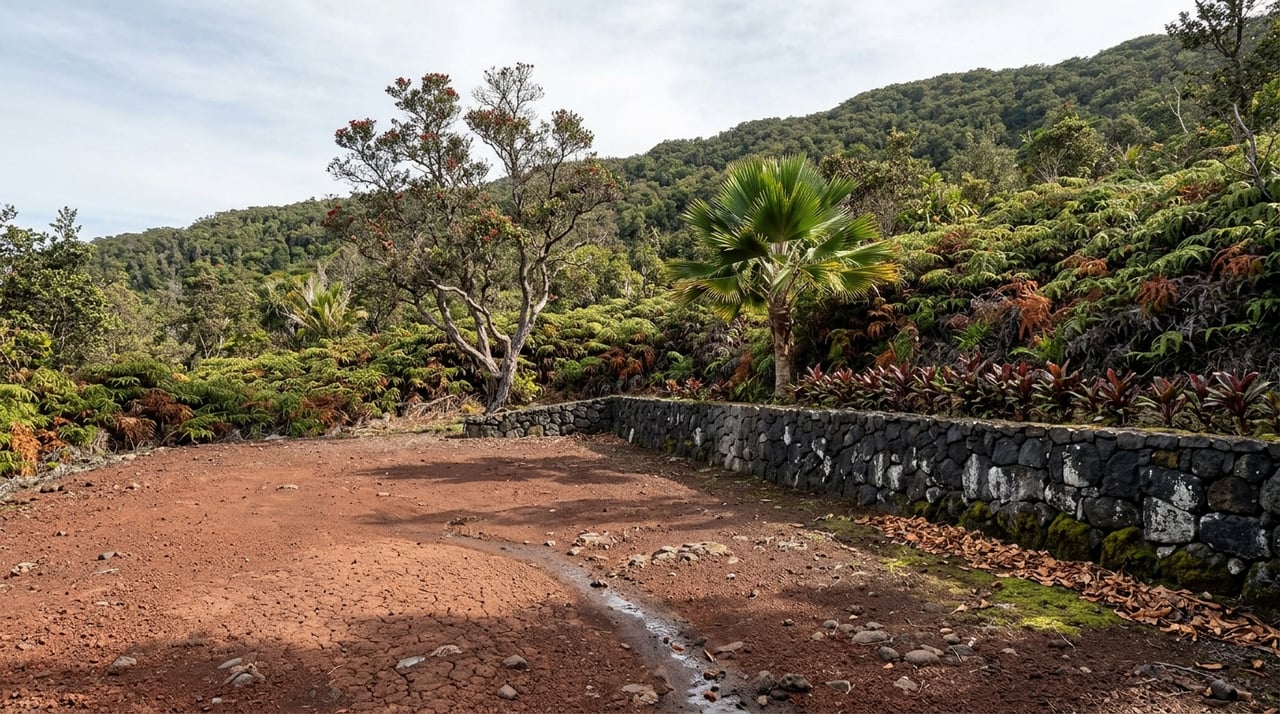
Why does five acres of North Shore agricultural land sometimes cost less per acre than a tenth of an acre in Manoa?
It is the question every serious land buyer on Oahu eventually asks, usually after running the numbers twice because the first pass seemed wrong. A bare lot in town, barely a tenth of an acre, can list for the better part of a million dollars. Meanwhile a five-acre parcel out past Kahuku, the kind that photographs beautifully with mountains behind it, can carry a price tag that works out to a fraction of that per acre. The spreadsheet says the rural acreage is the obvious value. The spreadsheet is missing the part where you actually try to build a house on it.
That gap between what raw land costs and what it takes to turn that land into a finished home is where most vacant land purchases on Oahu go sideways. Not at closing. Later, when the zoning department, the geotechnical engineer, and the framing contractor all show up with their own version of the bill.
Start with what the low price per acre is actually buying. Most of the vacant acreage marketed on Oahu's North Shore sits in the state's AG-1 agricultural district, and AG-1 comes with a structural catch that has nothing to do with soil quality. Honolulu's zoning code sets a minimum lot size of five acres for a single farm dwelling in AG-1, and clustering additional dwellings requires fifteen acres to get one unit per five. That is not a suggestion. It is written into the city's own agricultural cluster ordinance.
The bigger catch is what counts as a legal dwelling on that land in the first place. Hawaii Revised Statutes define a "farm dwelling" as a single-family home used in connection with a working farm, where agricultural activity actually provides income to the household living there. To build one, an owner has to file a farm plan with Honolulu's Department of Planning and Permitting and demonstrate that the home functions as an accessory to real agricultural use, not the other way around. You cannot buy AG-1 land purely because it is scenic and cheap and expect a straightforward building permit to follow.
This is exactly why several of the newer land offerings on the North Shore right now are not simple homesites at all. They are shares in newly formed condominium property regimes built around an existing, income-producing farm operation. A buyer isn't just acquiring dirt. They are buying into a working agricultural business that satisfies the legal requirement the house itself can't satisfy on its own. It is a clever structure, and it tells you something important: the friction here is real enough that sponsors have started building the workaround into the purchase itself.
State land use planners have been watching this exact pattern on Oahu for years. A 2019 law, Act 278, ordered a formal study of subdivision and condominium property regime practices on the island's agricultural lands, specifically because small-lot, non-farm residential development kept showing up disguised as agricultural use. The resulting 2020 report confirmed what buyers on the ground already suspected: the line between an agricultural parcel and a rural homesite is enforced on paper far more strictly than it appears in a listing photo.
Suppose the zoning clears and you're ready to build. The next number that changes the math is what construction itself costs here, and Hawaii is not competing with the mainland on this line item. Contractor estimates for a fully custom build on Oahu in 2026 generally run from the low $200s per square foot up toward $380 for higher finish levels, with everything from lumber to tile shipped over roughly 2,400 miles of ocean before it ever reaches a job site. That range alone puts a modest 2,000-square-foot home's construction cost somewhere between $460,000 and $760,000, before land, permits, or a single foot of driveway.
Set that against the value of an in-town lot for a moment. A vacant, R-5 zoned parcel in Manoa recently came to market at $835,000. It measures 4,673 square feet, just over a tenth of an acre. Do the arithmetic and that prices out to roughly $7.8 million an acre. It is not that in-town land is somehow better soil. It is that so little of Oahu is zoned Urban in the first place that any buildable lot inside that boundary commands a premium the rural acreage simply doesn't have to compete with. A 2020 state land use study found Oahu's Urban district covers only about 27 percent of the island's land area, with the rest split between Agricultural, at roughly 31.5 percent, and Conservation, at roughly 41.4 percent. Scarcity inside the Urban line is doing most of the work on that Manoa price tag.
Put those two facts side by side and the appeal of rural acreage starts to look less like a bargain and more like a trade: you give up the built-in Urban zoning premium, and in exchange you take on the AG-1 compliance burden described above. Neither side of that trade is free.
Even once zoning and construction costs are accounted for, the physical lot still has an opinion about your budget. A flat, slab-on-grade foundation on level ground runs roughly $30 to $42.50 per square foot in 2026. That is the easy case, the kind of lot found in newer, flatter subdivisions.
Much of Oahu's vacant acreage does not sit on flat ground. Sloped sites, common from Manoa to the North Shore, generally require a raised, post-and-pier foundation instead, and that system runs $40 to $70 or more per square foot depending on slope and pier height. On a steeper parcel, retaining walls to stabilize the building pad can add $150 to $300 per square foot of wall face on top of that, and newer city stormwater management rules for hillside development can tack on another $25,000 to $50,000 in grading and drainage work alone. A geotechnical survey, once treated as optional, is now the first item on the budget for any new Oahu build, precisely because volcanic soil composition varies enough from lot to lot that skipping the survey has become the expensive mistake, not the cost-saving shortcut.
Here is a rough illustration of how that stacks up across two common Oahu building scenarios, using the ranges above for a 2,000-square-foot home:
| Cost category | Flat, urban-zoned lot | Sloped, rural AG-1 lot |
|---|---|---|
| Foundation | $60,000–$85,000 (slab-on-grade) | $80,000–$140,000+ (post-and-pier) |
| Grading and stormwater | Minimal | $25,000–$50,000 |
| Construction (structure only) | $460,000–$760,000 | $460,000–$760,000 |
| Farm dwelling compliance | Not applicable | Farm plan, proof of agricultural income |
The construction line is identical. Everything above and below it isn't, and that's the part a per-acre asking price never shows you.
Here is where the conventional complaint about building on Oahu gets a genuine update. For years, the loudest friction wasn't zoning or foundations, it was the permitting counter itself, where residential applications could sit for six months or longer before anyone at the Department of Planning and Permitting even looked at the plans. That reputation is now out of date.
Honolulu's new permitting platform, HNL Build, replaced the decades-old POSSE system, and after a genuinely rough launch, the numbers have moved. Civil Beat's review of city data found the median wait time for a new building permit dropped to about 2.5 months in the eight-month stretch from August 2025 through April 2026, a 40 percent improvement over the same period a year earlier. A newer fast-track tool called CivCheck, rolled out for qualifying residential projects, cut prescreen review time from roughly 73 days down to about 32.5 days for a pilot group of applications, a reduction the city's own budget documents credit at close to 70 percent.
That matters for the thesis, not just as good news. For a long time, land buyers could point to the permitting backlog and blame the whole cost gap on government delay. That excuse is losing its power. If permitting keeps getting faster and the total cost of building on raw acreage still lands in the same neighborhood as buying a finished home, the real story was never mostly about bureaucracy. It was always the zoning classification and the physical site conditions doing the heavy lifting, and permitting speed was just the part everyone could see and complain about.
None of this means vacant land on Oahu is a bad idea. It means the comparison worth making isn't listing price per acre against listing price per acre. It's total delivered cost, built home against built home, with the zoning path, the foundation type, and the current permitting timeline all priced in before an offer goes in. A buyer weighing a five-acre AG-1 parcel against an already-finished home in Kahala or on the Gold Coast deserves a real answer to what the land actually costs to finish, not just what it costs to close on.
That is the kind of due diligence that separates a good land purchase from an expensive lesson in Hawaii zoning law. Elise Lee has spent nearly two decades working both sides of that comparison for Oahu buyers, from oceanfront estates to raw acreage, and knows exactly which questions to ask a seller's agent before a due diligence period runs out.
If you're weighing land against a finished home anywhere on Oahu, Elise Lee can walk through the real cost stack with you before you write an offer. Request a Private Consultation to get started.
Does buying into a North Shore CPR satisfy the farm dwelling requirement automatically? Not on its own. The CPR structure typically ties the property to an existing agricultural operation, but the underlying legal requirement, a bona fide farm plan filed with the city and proof that agricultural activity supports the household, still applies to the individual dwelling. Review the CPR's farm plan and income documentation as carefully as you would review the deed.
Can a five-acre AG-1 parcel ever be split into smaller homesites? Generally no, not for standard residential use. The five-acre minimum for a single farm dwelling in AG-1, and the fifteen-acre threshold for a clustered arrangement at one unit per five acres, are set in Honolulu's zoning code. State-level oversight also applies to agricultural parcels over fifteen acres, adding another layer of review beyond the county.
Stay up to date on the latest real estate trends.
Elise brings a fresh, creative international perspective to her Luxury Real Estate, Concierge & Interior Design career. She chairs the Honolulu Board of Realtors® City Affairs Committee, is on the Board of Directors for the Hawaii Economic Association, an Officer in the Confrérie de la Chaîne des Rôtisseurs Hawaii Bailliage.